Building research
Architecture of the castle
Ground plan, round tower and material – with scale drawings.
To the architecture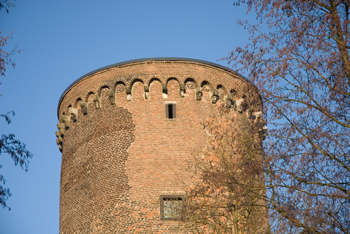
Witnesses of medieval life – discoveries spanning 700 years
Burg Uda stands on a remarkable foundation: hundreds of oak piles were driven into the marshy ground of the Niers meadows to support the massive masonry. This technique – comparable to the foundations of Venice – was an engineering masterpiece of the early 14th century.
The wet, oxygen-poor soil preserved the oak piles remarkably well over the centuries. During the excavations they could be documented and dated, providing valuable clues about the construction date of the castle.
Kurt Schietzel and the secrets of the castle
Between 1959 and 1962, extensive archaeological excavations were carried out at Burg Uda under the scientific direction of Kurt Schietzel from Hamburg. Working in the marshy Niers floodplain was demanding and required the constant use of pumps. A further excavation campaign followed in 1988.
In total, over 100 ceramic vessels and numerous other finds came to light, providing valuable insights into everyday life at the medieval castle.
Kurt Schietzel later became internationally renowned for his excavations of the Viking settlement of Haithabu (Hedeby) in Schleswig-Holstein. Burg Uda was one of his early excavation projects. His report "Burg Uda in Oedt" (ISBN: 3792705966) remains the definitive publication.
Treasures from different eras
One of the most spectacular finds from the castle's surroundings is a Viking sword dating from the 9th or 10th century – centuries before the castle was built. The find suggests that the area around the Niers ford was of strategic importance long before the castle's foundation. The sword with its characteristic broad blade and heavy pommel is a rare testimony to Norse presence on the Lower Rhine.
Even older is a Bronze Age sword found in the vicinity. It dates from approximately the 2nd millennium BC and proves that the region along the Niers was inhabited in prehistoric times. The sword is now in the Rhineland Regional Museum in Bonn and testifies to the millennia-old significance of this river crossing.
A cross-section of 600 years of history
Numerous ceramic fragments from the 14th to 16th centuries. Particularly noteworthy are bowls of blue-grey clay, dating back as far as the 11th century.
Fragments of glass vessels attest to the relative prosperity of the castle's inhabitants. Glass was a luxury item in the Middle Ages, often imported from the Rhineland or the Netherlands.
Among the metal finds, a bronze house bell stands out, likely used to assemble the castle's inhabitants. A well-preserved axe was also recovered.
Green-glazed stove tiles prove that the castle had tiled stoves – a sign of elevated living comfort in the Middle Ages.
The most remarkable single find is a medieval trippe (wooden overshoe), exceptionally well preserved in the peat soil of the Niers marshes – with leather remnants and nails still attached.
Cannonballs of various sizes are silent witnesses to armed conflicts. Remarkably, no weapons were found – unusual for a military fortress.
The objects span different eras, evidencing continuous use over centuries.
The archaeological finds can be viewed at two locations:
Display cases on the six floors of the castle tower show selected finds since the 2013 restoration. April–October, Sundays 11am–5pm.
In the basement of the former Girmes Villa (Johannes-Girmes-Straße 21). Every first Sunday of the month, 2–5pm (February–December). Free admission.
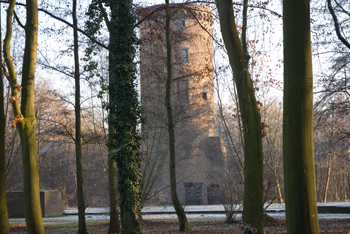
Explore Burg Uda and visit the local heritage museum to marvel at the finds.
Visitor InformationBuilding research, excavation history and sources
Ground plan, round tower and material – with scale drawings.
To the architectureThe archaeologist of the Oedt excavation – and later researcher of Haithabu.
To the personWhat these pages work from and how conflicting figures are handled.
To the sources