Legends & Tales
Mysterious stories from 700 years of castle history
Where walls are as old as those of Burg Uda, stories have always grown around the stonework. Generations of Oedt residents have told tales on long winter evenings – stories of enchanted castle maidens, hidden treasures and inexplicable apparitions. Here are the best-known legends surrounding Burg Uda.
The Enchanted Castle Maiden
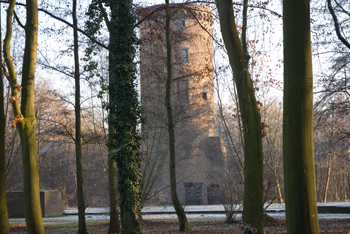
"On the nights around Midsummer, when the mist lies over the Niers meadows, a white figure is said to appear on the tower top of Burg Uda. It is the castle maiden who once lost her mind from unrequited love for a wandering knight and threw herself from the tower into the moat."
The tale of the enchanted castle maiden is the best-known legend of Burg Uda. It tells of a young noblewoman – some versions call her Adelheid, others Mechthild – who lived at the castle in the 15th century. A wandering knight who was a guest during a tournament in Oedt won her heart. But he rode on, and the maiden waited in vain for his return.
According to the legend, her ghost still appears on the tower on full-moon nights. Those who listen carefully are said to hear faint laments carried by the wind across the Niers meadows. Older Oedt residents report that on particularly still nights a faint light can be seen in the topmost tower window – even though the tower is locked at night.
The Origin of the Name "Uda"
The name of the castle – and thus of the town of Oedt – has occupied scholars and storytellers alike. The historical explanation is prosaic: "Hude" or "Ude" in Middle Low German meant a landing place or sheltered harbour on a river. The Niers was an important transport route for centuries, and a landing place likely existed at the site of the later castle.
But folk tradition tells a different story:
"Uda was the name of a herb-woman who lived in a hut on the banks of the Niers. She knew the healing power of every plant and cured the sick of the surrounding area. When a stern priest accused her of witchcraft, she vanished without a trace – but the people named the place after her ever since."
The linguistic derivation is well established: Hude (1170) → Ude → Uda → Uede → Oyde → Oidt → Oed → Oedt. It is even possible that the name goes back to a Roman settlement "loca huda" – a fortified river landing on the Niers.
The Hidden Treasure
"When Hessian soldiers set fire to the castle in 1643, the last bailiff is said to have hastily hidden the church treasure and the documents of the District of Oedt in an underground passage. The passage, so the story goes, leads from the castle beneath the Niers to St Vitus Church. Whoever finds it, finds the treasure."
The tale of an underground passage between castle and church is widespread across the Lower Rhine – almost every castle has such a legend. No such passage has ever been discovered in any excavation. The distance between castle and church is about 500 metres, and the marshy soil of the Niers meadows would have made building such a tunnel extremely difficult.
And yet: during the 1959–62 excavations, foundation remains were indeed discovered that could not be clearly identified. And the question of what became of the Oedt district archive when Hessian troops destroyed the castle remains historically unanswered.
The Ghost Coach of the Niers Ford
"On misty autumn evenings, when the Niers can barely be seen, one sometimes hears the rattle of a coach and the snorting of horses on the old road to the castle. But when you look, no one is there – only the crows take flight, as if something had passed by."
This more recent legend probably dates from the 18th or 19th century, when the castle ruins had already fallen into decay. It is associated with the last French officer who ordered the demolition of the castle in 1757. According to the legend, he regrets his deed and rides the road built from the castle's rubble for all eternity.
Facts and Legends
Where does history end and legend begin? At Burg Uda the boundaries blur. Discover the documented history and archaeological finds that cast some legends in a new light.