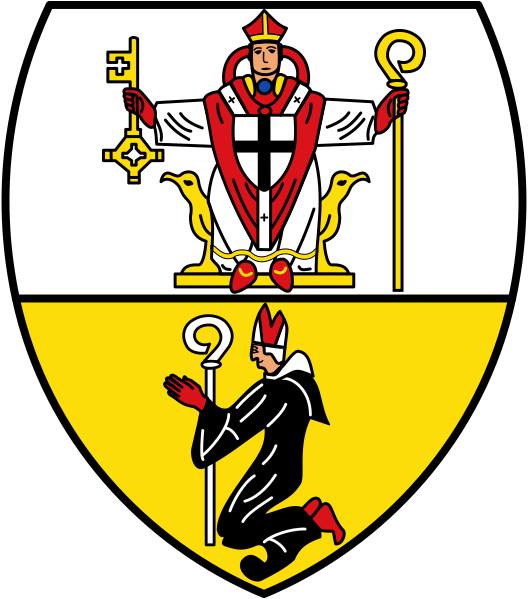
Person
Dietrich Luf III of Cleves
The builder: an indebted heir, seller of Hülchrath, lord of Kervenheim and Oedt.
To the person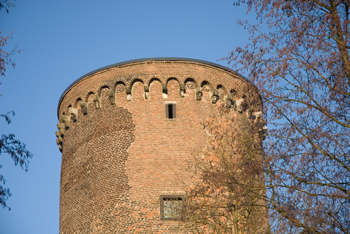
A bastion against time – more than 700 years of eventful history
The history of Burg Uda is closely intertwined with the political turmoil of the medieval Lower Rhine. Built as a moated castle and symbol of power by Dietrich Luf III of Kleve, it was a key fortress on the border of the Cologne territory. It endured sieges, destruction and rebuilding – yet settlement at the site reaches far back before the castle era.
The name "Oedt" derives from "Uda/Ude/Hude" – the castle gave the settlement its name. Archaeological finds point to habitation since Roman times: two large Roman building stones from Liedberg quarries were found near the church site. Researchers believe there was a small Roman settlement called "loca huda" – possibly a fortified river landing on the Niers.
Burg Uda was a moated castle – completely surrounded by a water-filled ditch fed by the River Niers. This position in the marshy Niers floodplain provided natural defence and made it one of the best-fortified sites on the Lower Rhine. It was also one of the earliest brick buildings in the region.
Burg Uda at the crossroads of medieval powers
Burg Uda did not arise in a political vacuum: in the late Middle Ages, Grefrath-Oedt lay in one of the most contested border regions of the Lower Rhine – the triangle between the Duchy of Kleve, the Duchy of Jülich and the Duchy of Guelders. The Archbishopric of Cologne, which became lord over the Lordship of Oedt from 1348, used the castle as a western bulwark against the expansionist ambitions of its neighbours.
This position made Burg Uda a politically and militarily highly significant object. Its history is therefore not only the history of a single building, but a mirror of the shifting balance of power on the Lower Rhine over more than three centuries.
Builder (1313):
Dietrich Luf III of Kleve – cadet branch of the Kleve comital dynasty
From 1348:
Archbishopric of Cologne – uses the castle as a western border fortress
Threats:
Duchy of Jülich (east), Duchy of Guelders (north),
County of Berg (south)
Stormed 1477:
Hessian troops acting for rival Cologne factions
The most important events at a glance
Archaeological evidence points to the construction of a Romanesque chapel at the site. The area comes into the possession of the Archbishopric of Cologne.
Archbishop Gero of Cologne donates the Oedt region to the Benedictine Abbey of Gladbach (Mönchengladbach).
Abbot Robert of Gladbach mentions "our church at Oedt" in an abbey document, naming St Vitus Church. This is the first written record of the settlement.
On 13 June 1313, the castle is first mentioned in historical records. Dietrich Luf III of Kleve, Count of Hülchrath, Lord of Kervenheim and Oedt, had the moated castle built as his seat of power. The nearly square complex, measuring 35 metres on each side with four corner towers, was one of the earliest brick buildings on the Lower Rhine.
Dietrich Luf III sells the County of Hülchrath to Archbishop Heinrich II of Virneburg. The proceeds may have funded the expansion of Burg Uda.
Dietrich Luf III dies. The lordship passes to his descendants. His daughter Elisabeth later marries Godart of Jülich.
Heiress Jolante sells the Lordship of Oedt. The castle serves the Elector of Cologne as a defence against the Duchies of Jülich and Guelders. The administrative district of Oedt is established.
In a feud between the Archbishop of Cologne and the Count of Berg, the settlement of Oedt is destroyed. However, Burg Uda is not taken – a testament to its defensive strength.
The castle is stormed during the Cologne Diocesan Feud by Hermann of Hesse. On 19 July 1477, peace is sealed "uff dem Durmel."
Extensive renovation work on the castle. The complex is adapted to contemporary needs.
On 17 January 1642, Imperial-Cologne troops are decisively defeated in the Battle of Kempen Heath. In 1643, Hessian troops under Colonel Rabenhaupt destroy the fortifications of Burg Uda by fire and explosives. The notorious "Hessian years" of brutal military occupation begin.
French officers order the demolition of the castle complex. The rubble is used to build a road through the Niers marshes. Of the once mighty moated castle, only the south-eastern round tower survives.
The municipality of Oedt acquires Burg Uda. Initial restoration work on the tower follows in 1957.
Under the direction of Kurt Schietzel, extensive archaeological excavations take place. Over 100 ceramic vessels and numerous other finds come to light. Schietzel later became internationally renowned for his work at the Viking settlement of Haithabu.
Oedt loses its independence and becomes a district of the municipality of Grefrath in the Viersen district.
A multi-year restoration project secures the tower for the future. On 28 September 2013, the anniversary "700 Years of Burg Uda" is celebrated with a grand festival. The tower receives a new viewing platform, information panels and display cases with finds.
Burg Uda is a protected monument, popular excursion destination and landmark of Oedt. The Heimatverein Oedt e.V. with around 570 members maintains the site and regularly offers guided tours, the Burgspektakulum and other events.
A moated castle with a ditch fed by the River Niers
Burg Uda was built as a moated castle – a fortification surrounded by a water-filled ditch fed by the River Niers. The nearly square ground plan with four corner towers made it an outstanding structure of its time. With external dimensions of approximately 35 x 35 metres and a courtyard of 18.70 x 23 metres, the complex accommodated residential and service buildings.
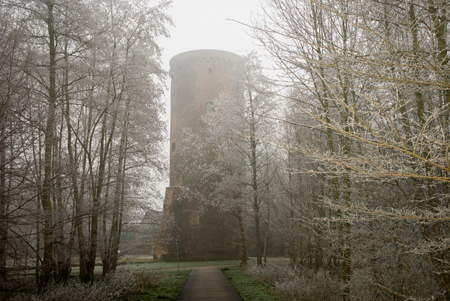
Of the original four corner towers, only the south-eastern round tower survives today. With an external diameter of 9.49 metres and 2-metre-thick walls, it houses remarkable details across 5-6 storeys: a Gothic ribbed vault on the second floor, remains of a tuff stone fireplace on the fourth floor, and a pointed arch frieze on projecting corbels.
In terms of architectural history, Burg Uda holds particular regional significance: it is one of the earliest brick buildings on the Lower Rhine. While natural stone still dominated the Rhineland in the early 14th century, Dietrich Luf III and his builders consistently used fired brick – a material that originated from the flat, stone-free Lower Rhine lowlands and would give the region its distinctive character in the centuries to come. In this sense, Burg Uda is not only a military document but also one of architectural history.
Count of Hülchrath, Lord of Kervenheim and Oedt – a colourful figure of the medieval Lower Rhine. As a scion of a cadet branch of the Kleve comital dynasty, he navigated between competing power blocs. In 1314 he sold the County of Hülchrath to the Archbishopric of Cologne to secure his alliance and fund the expansion of his castle. He died in 1332 – his legacy, the tower of Burg Uda, has overlooked the Niers meadows for more than 700 years.
Archaeological FindsBuilder, building and lordship in detail
The builder: an indebted heir, seller of Hülchrath, lord of Kervenheim and Oedt.
To the personGround plan, round tower and material – with scale drawings.
To the architectureFrom an advocacy of the counts of Kessel to a territorial castle of Cologne.
To the lordship